
The RUO Startup Stack I Would Build From Scratch in 2026
If I had to launch a new RUO peptide company from zero in 2026, I would build it very differently than I did a few years ago.
The industry is more competitive, payment processing is harder, customers are more educated, testing expectations are higher, and simply throwing 50 peptide SKUs onto a WooCommerce store is no longer much of a strategy.
After helping build, operate, market, and scale multiple RUO businesses, this is the stack I would focus on today.
1. Start With the Business Model, Not the Website
Before worrying about logos or themes, I would decide exactly what kind of RUO company I am building.
Are we competing on:
- Price
- Premium branding
- Testing
- Customer service
- Product selection
- Community
- Wholesale
- Specialty formats
- Fast domestic fulfillment
- Education and research content
Trying to be everything usually creates a generic peptide website with no reason for someone to remember it.
The brand needs a position.
That position affects everything that follows.
2. Business Structure, Banking and Documentation
I would get the operational foundation organized before launch.
That means properly structured business entities, business banking, accounting, vendor documentation, policies, terms, privacy disclosures, fulfillment procedures, testing documentation, and clear Research Use Only positioning.
This stuff is boring until your processor, bank, supplier, testing lab, or business partner asks for it.
Then it becomes extremely important.
One mistake I see newer founders make is building the public-facing company first and worrying about the back end later.
I would do the opposite.
3. Build the Supply Chain Before Building the Product Catalog
I would not launch with 100 SKUs just because I can source them.
I would start with a controlled group of products where I understand:
- Actual landed cost
- Supplier reliability
- Batch consistency
- Testing cost
- Lead times
- Minimum order quantities
- Packaging costs
- Replacement procedures
- Inventory turnover
- Expected retail margin
Cheap acquisition cost means very little if batches are inconsistent or inventory takes months to arrive.
Your supplier is one of the most important relationships in the entire business.
4. Independent Testing and COA Infrastructure
Testing should be treated as infrastructure, not marketing decoration.
At minimum, I want a clear system for organizing batch documentation and third-party analytical results where applicable.
Depending on the product and testing program, that can include things such as:
- Identity
- Purity
- Assay / quantity
- Sterility testing
- Endotoxin testing
I also prefer having a structured COA library tied to lot or batch information rather than randomly uploading PDFs onto product pages.
Customers notice organization.
So do business partners.
5. Branding That Doesn’t Look Like Every Other Peptide Store
A lot of RUO sites still look almost identical.
White background.
Blue gradient.
Molecule graphics.
Generic vial renders.
Twenty products on the homepage.
There is nothing inherently wrong with that, but differentiation matters more now.
I would invest in:
- Full logo system
- Brand colors
- Typography
- Packaging system
- Product photography or renders
- Custom graphic elements
- Consistent email design
- Social templates
A strong brand makes everything downstream easier.
Advertising looks better.
Emails look better.
Affiliate content looks better.
Customers remember you.
6. WooCommerce Ecommerce Infrastructure
For most RUO stores we work with, I still like having a highly customizable ecommerce environment where the company has significant control over the customer experience and integrations.
The important part isn’t just picking a platform.
It is building the system around it.
My basic stack would include:
- Fast hosting
- Mobile-first design
- Clean product navigation
- Search
- Customer accounts
- COA library
- Email capture
- Affiliate tracking
- Loyalty system
- Analytics
- Conversion tracking
- Abandoned cart recovery
- Order tracking
- Customer support workflow
- Inventory management
The website should be treated like operating infrastructure, not a digital brochure.
7. Payment Processing Needs to Be Designed Early
This is probably one of the most underestimated parts of launching an RUO company.
Do not build the entire company and then ask:
“How are we going to take payments?”
Payment options, underwriting requirements, chargeback exposure, reserves, banking relationships, KYB requirements, checkout flow, and processor policies should be considered during the build.
I also would never want the entire company dependent on one payment rail.
That doesn’t mean trying to hide what you’re selling.
It means building legitimate redundancy.
Depending on what a business qualifies for, that may include combinations of:
- Card processing
- ACH
- Bank-based payments
- Crypto
- Other approved alternative payment methods
The goal should be sustainable payment infrastructure that accurately represents the business and fits the policies of the providers being used.
8. Build Email Marketing Before You Need It
Email is one of the highest-leverage assets an ecommerce brand can own.
Yet I constantly see businesses doing significant revenue with almost no email infrastructure.
Before launch I would have:
Welcome Flow
Introduce the company, positioning, testing standards, research focus, and brand story.
Abandoned Cart Flow
Recover customers who didn’t finish checkout.
Post-Purchase Flow
Order information, education, support, and future engagement.
VIP Flow
Identify and nurture your highest-value customers.
Winback Flow
Re-engage customers who haven’t purchased recently.
Then I would send regular broadcasts around inventory, educational content, testing updates, new products, and promotions.
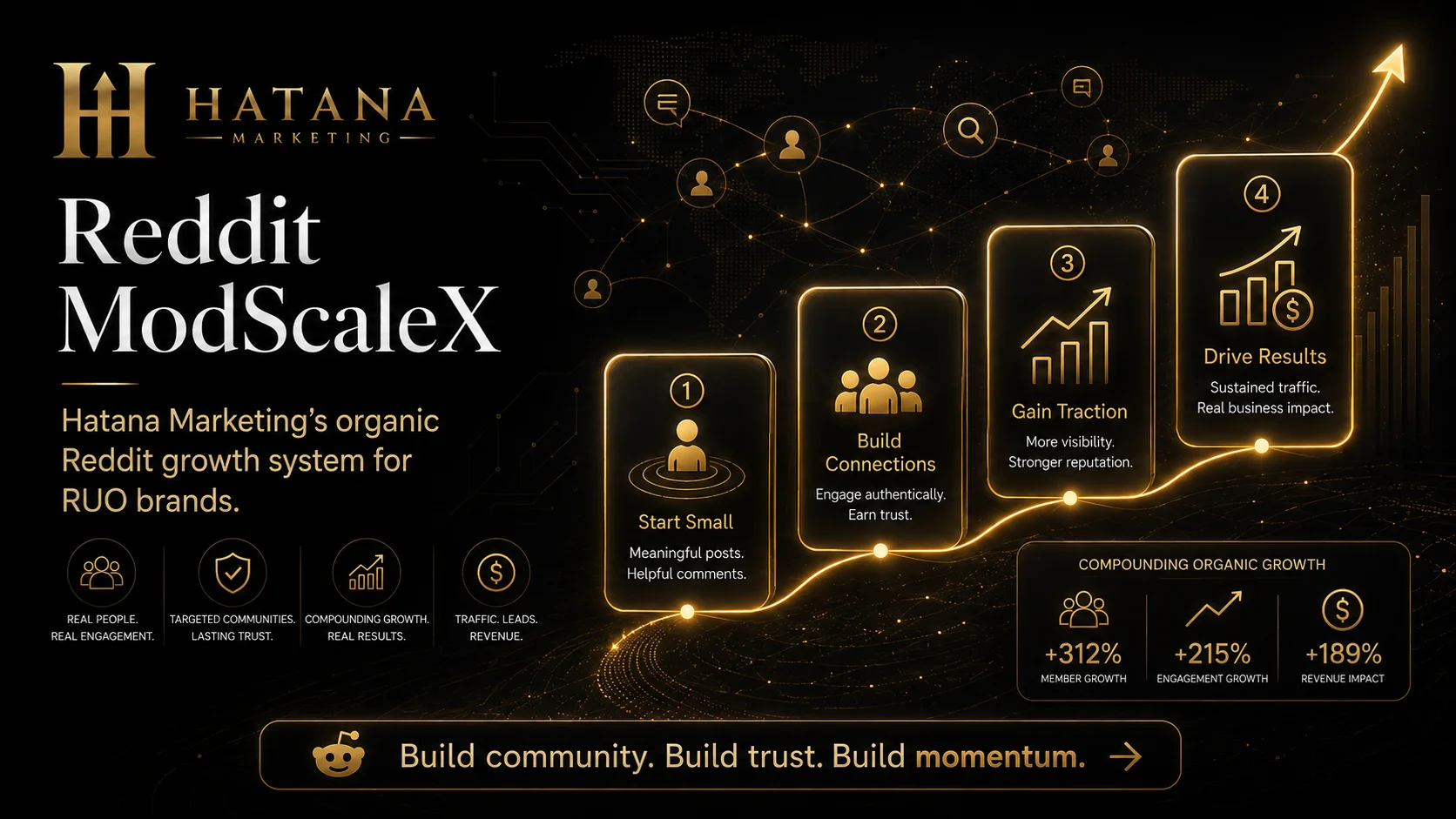
9. Reddit Before Paid Advertising
If I had a limited marketing budget, I would focus heavily on organic search and Reddit before dumping money into paid traffic.
Reddit has been one of the strongest channels I have personally seen in this niche.
But there is a massive difference between Reddit marketing and Reddit spam.
I would focus on:
- Helpful educational posts
- Searchable long-form content
- Founder participation
- Niche subreddit communities
- Product-category discussions
- Research discussions
- SEO-focused Reddit threads
- Community moderation
- Answering real customer questions
Over time you create an ecosystem.
Someone searches Google.
They find your Reddit thread.
They read your content.
They discover your community.
They join your email list.
Eventually they discover the business.
That is much more durable than posting discount codes everywhere.
10. Build the Affiliate Program Early, But Manage It
Affiliates can become an incredible acquisition channel in RUO.
They can also become a mess.
I would have clear rules around:
- Commission rates
- Attribution
- Coupon usage
- Payout schedules
- Brand representation
- Promotional claims
- Paid advertising
- Search marketing
- Spam
- Sub-affiliates
The important part is actively managing the program.
Your best affiliates should feel like partners, not anonymous coupon codes.
11. SEO From Day One
Most founders think about SEO six months after launching.
I would structure it from the beginning.
That means building pages around actual search intent:
- Product categories
- Research compound information
- Testing information
- COA documentation
- Company policies
- Frequently asked questions
- Educational resources
- Wholesale
- Shipping
- Research-use documentation
Then use supporting content across Google, Reddit, social media, and email.
SEO becomes much easier when the entire information architecture was built correctly from day one.
12. Paid Advertising Comes After the Infrastructure
I would not seriously scale paid traffic until the website can convert and retain customers.
Before increasing ad spend, I want to know:
- Conversion rate
- Average order value
- Gross margin
- Contribution margin
- Customer acquisition cost
- Repeat purchase rate
- Email revenue
- Affiliate revenue
- Refund rate
- Chargeback rate
- Payment acceptance rate
If those numbers don’t make sense, advertising usually just helps you lose money faster.
Paid acquisition should amplify something that already works.
13. Customer Service Is Part of Marketing
This gets overlooked constantly.
Fast support creates repeat customers.
Slow support destroys trust.
I would build a simple customer-service system for:
- Order status
- Tracking
- Payment questions
- Product questions
- Testing documentation
- Damaged shipments
- Returns
- Replacements
- Wholesale inquiries
And I would document common responses so the support team can answer consistently.
14. Build Wholesale Infrastructure Earlier Than Most People Do
Retail gets most of the attention, but wholesale can become a major revenue channel.
I would have systems for:
- Tiered pricing
- Minimum order quantities
- Custom quotes
- Bulk testing
- Packaging options
- Private-label opportunities
- Inventory availability
- Sales follow-up
- CRM tracking
A few strong B2B relationships can sometimes be worth more than hundreds of small retail orders.
15. Know Your Unit Economics
This might be the most important piece.
Your $120 product does not have a $113 profit margin because the vial cost you $7.
Real economics include:
Product cost
- freight
- testing
- packaging
- fulfillment
- payment fees
- affiliate commissions
- discounts
- refunds
- replacements
- payroll
- advertising
- software
- overhead
Then you can calculate what you can actually afford to spend acquiring customers.
This is where a lot of fast-growing ecommerce businesses get themselves into trouble.
Revenue screenshots are fun.
Contribution margin pays the bills.
The Full RUO Stack
If I were starting again, I would think about the business in this order:
Positioning → Structure → Sourcing → Testing → Branding → Website → Payments → Email → Reddit → Affiliates → SEO → Paid Advertising → Retention → Wholesale → Scale
That is the biggest lesson I have learned.
An RUO company is not a website with peptide products attached to it.
It is an interconnected operating system.
If your sourcing is weak, marketing can’t save you.
If your payments are unstable, advertising can’t save you.
If your site doesn’t convert, traffic can’t save you.
If customers don’t come back, acquisition eventually becomes too expensive.
The businesses that survive are usually the ones that build the whole machine.
I’ve spent the last few years working inside these businesses rather than only consulting from the outside, and that experience is ultimately what led us to build Hatana Marketing around the entire RUO operating stack instead of traditional marketing services alone.
If people are interested, I’ll make a few follow-up posts breaking down individual parts of the stack, especially RUO payment infrastructure, Reddit organic growth, sourcing economics, website architecture, and affiliate systems.
If you’re building an RUO brand and need help with any part of the stack, from web design, sourcing, payments and compliance infrastructure to Reddit, email, SEO, affiliates or paid acquisition, Hatana can help you build it properly from the ground up or optimize what you already have.
Need help with your RUO business?
Contact Hatana Marketing and tell us what you’re working on. We’ll help identify the biggest bottlenecks and determine which systems we can handle for you.
Ready to skip the call and just get signed up? Sign Up link are inside this article below.
RUO Payment Processing: How Peptide Companies Can Build a Reliable Payment Stack – Hatana Marketing