
Payment processing is one of the first major roadblocks most RUO peptide companies eventually encounter.
The frustrating part is that the payment solution available to a brand doing $5,000 per month is often completely different from what becomes available once that same company is consistently processing $50,000, $100,000 or more per month.
I’ve learned this firsthand operating RUO companies.
The mistake I see founders make is waiting for the “perfect” credit card processor before they start building volume.
I take the opposite approach.
Get legitimate payment infrastructure in place, start generating sales, establish processing history, build your documentation, control your chargebacks, and graduate into better payment options as your business becomes stronger.
You don’t necessarily need the final payment stack on day one.
You need a path to get there.
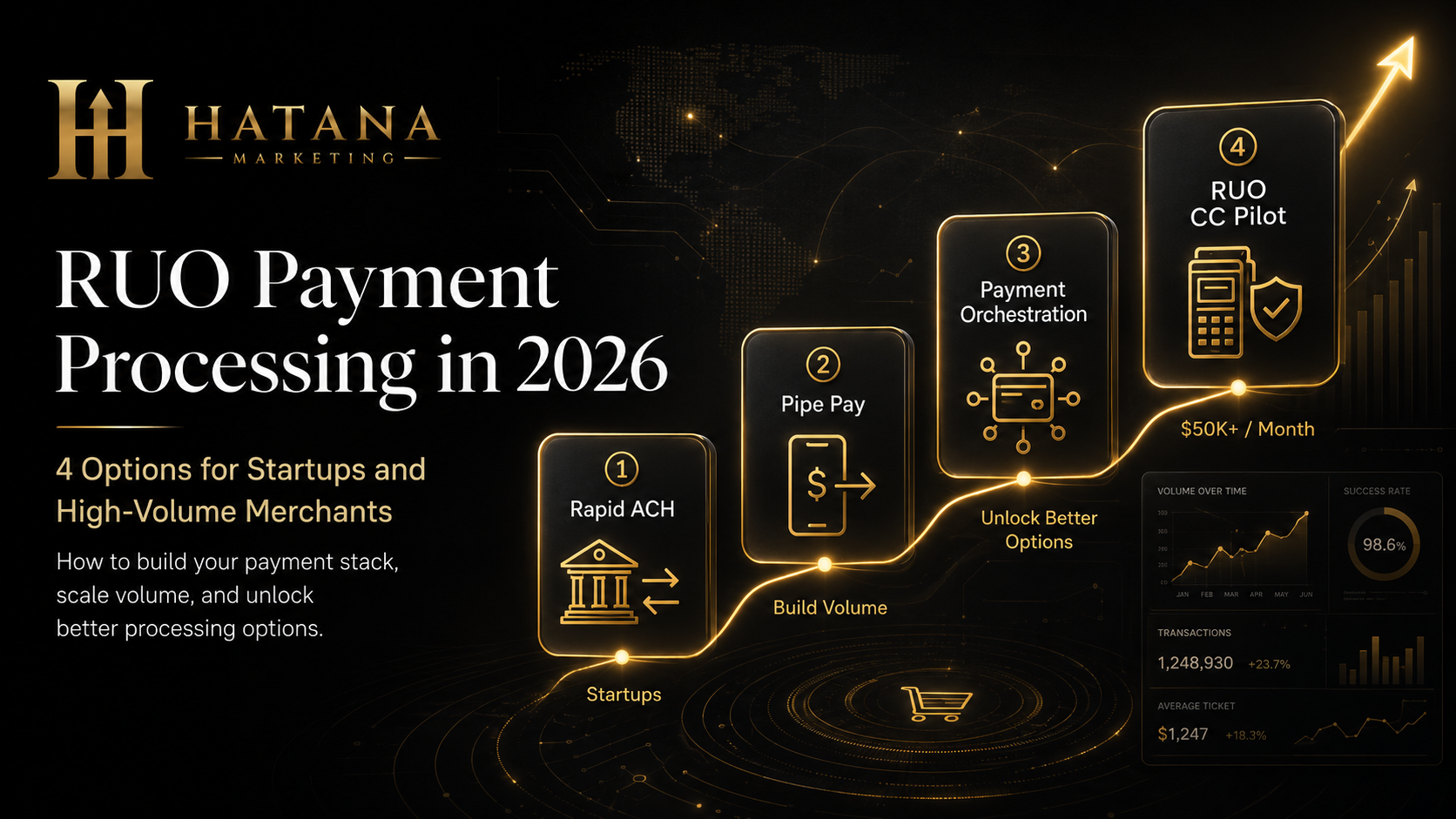
After working through more payment processors than I care to count, these are four of the strongest options I currently use or recommend for different stages of an RUO business.
Important: Every payment provider has its own underwriting, compliance and acceptable-use requirements. Approval, rates, reserves and settlement schedules can vary by merchant. Your business should always be represented accurately during underwriting.
The RUO Payment Processing Ladder
The way I think about RUO payments today looks something like this:
Startup
Rapid ACH + P2P infastructure
↓
Growing Merchant
ACH + card processing when available
↓
Established Merchant
ACH + P2P + specialty card processing
↓
$50K+ Monthly Volume
Stronger underwritten card programs + ACH backup + redundant payment rails = full RUO payment stack
The objective isn’t to replace one unstable processor with another.
The objective is to gradually build a payment stack.
Option 1: Rapid ACH
Best for: Startups and every RUO merchant that wants a strong backup payment rail
If I were launching an RUO business from zero today, Rapid ACH would be one of the first payment options I would apply for.
This is also probably my favorite backup payment method for established RUO stores.
Why?
Because it’s fundamentally different from credit card processing.
Instead of the customer paying through card rails, they connect their bank and pay through a bank-to-bank payment system.
For the RUO merchants we work with, current specialty pricing is typically around 8% with no reserve and daily payouts, subject to underwriting and the merchant’s approved terms.
But the feature I care about most is the payment guarantee.
The underlying Pay by Bank technology uses real-time decisioning and can guarantee qualifying accepted transactions. The provider specifically states that qualifying transactions can be covered against common ACH return codes including insufficient funds.
That’s a major improvement over traditional ACH.
With ordinary ACH, merchants often hesitate to immediately fulfill an order because a payment can later return for insufficient funds.
With qualifying guaranteed Pay by Bank transactions, much of that NSF risk can be removed from the merchant.
That can allow an RUO store to confidently move an approved order into fulfillment much faster instead of automatically waiting several days for traditional ACH settlement.
Another advantage: Returning customers
The first bank connection requires the customer to authenticate their bank account.
After that, returning-user functionality can make repeat purchases significantly easier. The platform supports stored or secure returning-account flows designed to recreate much of the convenience customers expect from a saved card experience.
This leads to one of my favorite strategies when introducing ACH:
Pro Tip: Incentivize the first bank connection
When you first add Rapid ACH, consider giving customers a temporary discount for choosing bank payment.
You’re essentially paying to change customer behavior.
Once a customer has connected their bank and successfully completed that first transaction, paying that way again becomes much easier.
Instead of looking at the discount as lost margin, I look at it as customer acquisition for a payment rail I want them to continue using.
Who should use Rapid ACH?
I like it for:
- Brand-new RUO companies
- Merchants that have lost credit card processing
- Merchants waiting on card underwriting
- Established stores that want payment redundancy
- Stores looking to reduce their dependence on credit cards
Even when my credit card processing is running perfectly, I still want ACH available.
Apply for Rapid ACH through Hatana:
HatanaLink.com
We’ll review your business and help determine whether it’s a fit before moving it into underwriting.
Option 2: Pipe Pay
Best for: Early-stage merchants that need a flexible alternative checkout
The second tool is different because Pipe Pay isn’t a traditional payment processor.
It’s a WooCommerce plugin built to manage and verify P2P payments.
Pipe Pay supports payment workflows involving Venmo, Cash App, PayPal and Zelle. Customers select the payment method, complete payment, upload payment proof, and Pipe Pay can use AI to verify the screenshot and automatically update the WooCommerce order when confidence is high enough.
This solves one of the biggest operational problems with P2P payments.
Without automation, someone on your team has to constantly:
Check the payment app.
Find the customer.
Compare the amount.
Match it to WooCommerce.
Mark the order paid.
Repeat.
That gets old very quickly at any meaningful order volume.
Pipe Pay automates much of that workflow.
It also supports multiple configured payment accounts, QR codes, payment-method controls, manual review and AI-assisted proof verification.
Where I think Pipe Pay fits
I don’t view P2P as the final payment infrastructure for a seven-figure ecommerce business.
I view it as another tool in the stack.
For a startup doing relatively low volume, it can help the company begin collecting revenue while building the processing history needed to qualify for more sophisticated options later.
For established merchants, it can also provide another alternative payment path if other rails are experiencing downtime.
One important caveat:
Only use P2P accounts and payment methods in ways permitted by the underlying provider.
Pipe Pay can automate the checkout and verification workflow, but merchants are still responsible for complying with the terms and business-use requirements of Venmo, Cash App, PayPal, Zelle and any other connected service.
Do not use account rotation to circumvent provider restrictions or account limits.
Try Pipe Pay
Pipe Pay currently offers a 7-day free trial for annual plans. Its official site lists support for WooCommerce and multiple P2P methods.
Start a 7-Day Pipe Pay Trial
Use code BOB for 5% off.
Option 3: Kashu Payment Orchestration
Best for: Growing RUO companies that want card acceptance and a more polished payment layer
Once an RUO business has started generating meaningful sales, I like to begin looking at more sophisticated card-processing infrastructure.
One option we’ve been working with is Kashu.
Kashu offers merchant payment acceptance across debit cards, credit cards, ACH and other payment methods. Its public merchant-processing materials currently list support for Visa, Mastercard, Discover and American Express.
For the specialty RUO merchants we’ve worked with, a more realistic underwriting structure has often been around:
8% processing
5% rolling reserve
These are not Kashu’s general advertised retail rates. Specialty merchant pricing is determined through underwriting and can differ materially based on industry, volume, risk profile and processing history.
That’s important because you’ll sometimes see a processor’s public pricing and assume that is what an RUO company will receive.
Usually it isn’t.
High-risk and specialty underwriting is its own world.
Why I Like the Checkout
One detail I particularly like for RUO ecommerce is showing customers clear payment information and the merchant’s statement descriptor during checkout.
That sounds small.
It isn’t.
One of the easiest ways to create unnecessary chargebacks is having customers see a company name they don’t immediately recognize on their bank statement.
You want the customer to know:
“This is what your purchase will appear as on your statement.”
Setting that expectation at checkout can help reduce confusion later.
The downside: Onboarding
This isn’t usually the option I recommend for someone who registered an LLC yesterday and has never processed a transaction.
Onboarding can require more documentation and coordination.
That’s not necessarily a negative.
As payment options improve, underwriting normally becomes more serious.
Your website, business structure, policies, transaction history, chargeback profile and documentation increasingly matter.
This is exactly why building volume responsibly with earlier-stage payment systems can become so valuable.
You’re building evidence that your business actually operates.
Apply for Kashu
Apply for Kashu Payment Processing
Approval, rates, reserves and settlement terms remain subject to underwriting.
Option 4: Hatana’s RUO Credit Card Processing Pilot
Best for: Established RUO merchants processing $50,000+ per month
This is where things get interesting.
If you’re already doing more than $50,000 per month, I don’t necessarily want to send you directly into the same processing solutions I recommend for a startup.
At that level, your processing history itself becomes valuable.
You can demonstrate:
- Real transaction volume
- Average order value
- Chargeback history
- Refund history
- Fulfillment performance
- Business longevity
- Banking history
- Customer-service infrastructure
- Website quality
- Compliance controls
Those things can open doors that simply aren’t available to a company doing $2,000 per month.
Hatana currently has a limited number of openings in our RUO Payment Pilot Program for established merchants processing more than $50K monthly.
This is the card-processing infrastructure I prioritize for our own established RUO operations.
Because capacity is limited and underwriting is more involved, I prefer personally reviewing these merchants before we submit anything.
If you’re already processing more than $50K per month:
Book a Payment Processing Call With Hatana
Include your current monthly volume and existing payment stack when you contact us.
If the business qualifies, we’ll help you prepare the application and prioritize the onboarding process.
Don’t Wait Until $50K/Month to Build Your Payment History
This is probably the most important lesson in this entire article.
A startup founder might look at the final option and think:
“I want that processor. Why can’t I just start there?”
Sometimes you can.
Often you can’t.
Payment underwriting is partly about proving that your company can responsibly process volume.
That’s why I like building businesses in stages.
Start with legitimate options you can actually obtain.
Generate transactions.
Ship orders successfully.
Keep your refund rate under control.
Keep chargebacks under control.
Maintain clean banking activity.
Build customer-service systems.
Document your business.
Then periodically re-evaluate your payment options.
Your first processor doesn’t have to be your last processor.
Volume Creates Leverage
A merchant doing $3,000 per month is largely asking a processor to take a chance on them.
A merchant doing $100,000 per month with clean processing history is bringing something valuable to the table.
That changes the conversation.
The stronger your company becomes, the more leverage you potentially gain around:
- Processing rates
- Reserves
- Settlement schedules
- Transaction limits
- Payment methods
- Banking relationships
- Redundant merchant accounts
This is why payment infrastructure and business growth should be developed together.
The Payment Stack I Would Build From Scratch
If I were launching another RUO company today, I would probably build the payment stack roughly like this:
Stage 1: Startup
Rapid ACH + approved alternative payment options
Start collecting legitimate transaction history.
Stage 2: Early Growth
Rapid ACH + Pipe Pay + available card processing
Give customers multiple ways to pay while reducing dependence on any one rail.
Stage 3: Established Merchant
Rapid ACH + specialty card processing + payment orchestration
Begin shifting more volume toward scalable merchant infrastructure.
Stage 4: $50K+ Monthly
Primary RUO card processing + Rapid ACH + secondary payment rails
At this point I’m focused heavily on redundancy, conversion rate and negotiating better processing economics.
Notice that Rapid ACH never really disappears from the stack.
That’s intentional.
It remains one of my favorite backups even after better card-processing options become available.
Build the Business That Qualifies for Better Processing
The biggest change in my thinking over the years has been realizing that payment processing isn’t something separate from the business.
Your website matters.
Your customer service matters.
Your fulfillment matters.
Your chargebacks matter.
Your documentation matters.
Your processing history matters.
Your volume matters.
If you’re constantly getting rejected by better processors, don’t only ask:
“Where can I apply next?”
Also ask:
“What does my business need to look like six months from now so better processors want me?”
Sometimes the answer is simply building legitimate volume through the options available today.
That’s where Rapid ACH, Pipe Pay and other specialty payment systems can play an important role.
They give you somewhere to start.
Then as the company grows, you graduate.
Need Help Building Your RUO Payment Stack?
Hatana Marketing works with RUO companies at very different stages.
If you’re launching from scratch, we’ll help determine which payment options make sense now and what you need to build toward.
If you’re already doing significant volume, we can review your existing payment stack and determine whether stronger card-processing options are available.
Startup or need Rapid ACH?
Apply at HatanaLink.com
Want a P2P checkout backup?
Try Pipe Pay free for 7 days
Use code BOB for 5% off.
Want to apply for Kashu?
Apply for Kashu here
Processing $50K+ per month?
Book a call with Hatana Marketing
We’ll review your business, current processing volume and existing infrastructure to determine which options you may qualify for.
The goal isn’t finding one payment processor that lasts forever. The goal is building a payment stack strong enough that losing one processor doesn’t stop your business.
Disclosure
Some links in this article may be referral links, and Hatana Marketing may receive compensation when a merchant signs up through them. Any referral relationship does not guarantee approval. Rates, reserves, settlement schedules and merchant eligibility are determined by the individual payment provider and its underwriting partners.