By Hunter Hodges, Founder of Hatana Marketing
Updated September 2, 2026
Payment processing is one of the biggest threats to an otherwise healthy RUO peptide company.
A business can have great products, professional testing, a high-converting website, strong customer retention, and thousands of loyal customers. None of that matters when the processor suddenly stops accepting payments, freezes settlements, or terminates the merchant account.
I know this from experience.
I have spent years building and operating RUO brands, scaling companies from launch into seven-figure businesses, and helping other research companies solve problems involving payment processing, compliance, web development, affiliate marketing, email automation, and customer acquisition.
During that time, payment processing has consistently been one of the most difficult parts of operating in the RUO industry.
I have dealt with sudden processor terminations, held funds, unreliable support, vague statement descriptors, poor checkout integrations, and providers that clearly did not understand the business they had approved.
Those experiences changed the way I evaluate an RUO payment processor.
I am no longer looking for the cheapest advertised rate. I am looking for stability, transparency, responsive support, reliable settlements, a checkout that converts, and a team that understands what the business actually sells.
After using Kashu Pay for a little over a month, it has become one of the best merchant-facing payment solutions I have used for a properly disclosed RUO peptide company.
It is not cheap. It is not perfect. It is also not a magic solution for every research company.
But it works.
My Kashu Pay Terms at a Glance
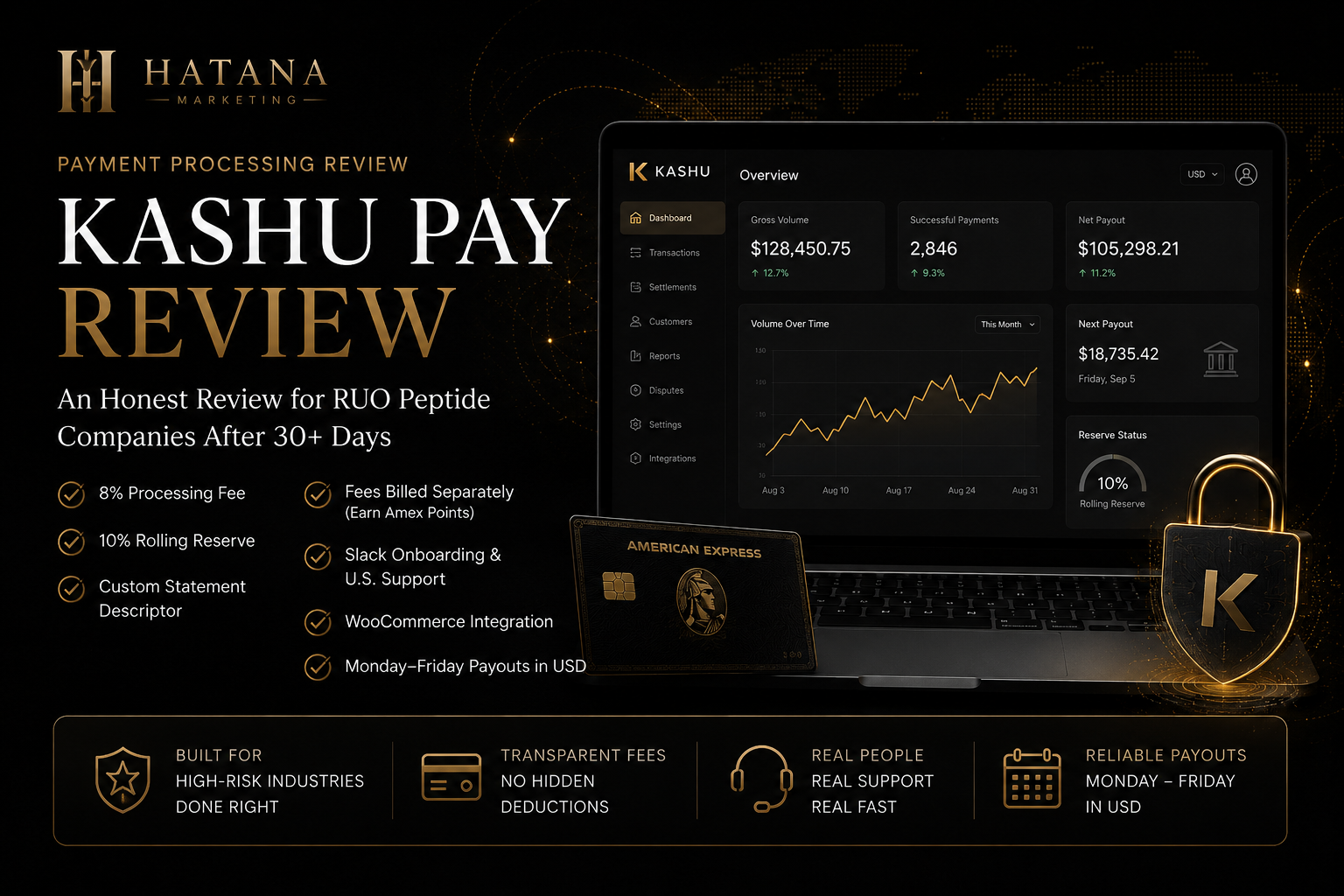
These are the terms and features of my specific Kashu merchant account:
| Feature | My Experience |
|---|---|
| Processing fee | 8% |
| Rolling reserve | 10% |
| Settlement currency | USD |
| Payout schedule | Monday through Friday |
| Statement descriptor | Custom merchant descriptor |
| Processing fee billing | Billed separately from payouts |
| Customer support | Shared Slack channel |
| Support team | U.S.-based team |
| Website platform | WooCommerce |
| Integration experience | Functional after custom adjustments |
| Time using Kashu | More than 30 days |
These are my approved terms. Another merchant may receive different rates, reserve requirements, settlement terms, or underwriting conditions.
What Is Kashu Pay?
From the merchant side, I think of Kashu as a PayFac-style payment processing layer.
Kashu provides the merchant-facing onboarding, technical integration, support, account management, and payment tools surrounding the underlying processing relationship.
This distinction matters because Kashu is the team I communicate with when I need help, but payment processing still involves acquiring institutions, banking partners, card networks, underwriting requirements, and risk controls.
No payment provider has unlimited control over every hold, reserve, settlement, or card-network decision.
What Kashu does well is create a much better merchant experience around that infrastructure.
Instead of dealing with a generic support portal, I have direct communication with a team that understands my account and can help work through both technical and operational problems.
Is an 8% Processing Fee Expensive?
Yes.
An 8% processing fee is expensive compared to a standard low-risk Stripe, PayPal, or traditional merchant account.
But that is not the correct comparison for an RUO peptide company.
The correct comparison is against other processors that are willing to knowingly review and underwrite the actual business, including:
- The products being sold
- The website and checkout
- The company ownership
- The marketing language
- The fulfillment process
- The refund policy
- The transaction history
- The expected monthly volume
- The chargeback profile
- The overall compliance structure
A cheap merchant account that gets terminated without warning can cost considerably more than a stable account with a higher rate.
Every time an RUO company loses payment processing, it risks losing revenue, customer trust, advertising momentum, email conversion, affiliate confidence, and recurring purchase behavior.
A processor should not be judged only by the percentage printed on the fee schedule.
It should be judged by the value of the revenue it allows the business to reliably collect.
For my business, stability is worth more than a low headline rate.
How the 10% Rolling Reserve Works
My Kashu account has a 10% rolling reserve.
A rolling reserve is not the same thing as an additional 10% processing fee. It is money withheld from settlements to protect against future refunds, disputes, chargebacks, and other merchant liabilities.
The reserved funds should be released according to the reserve schedule established in the merchant agreement.
For example, on a simplified $100 transaction:
- $10 may be placed into the rolling reserve.
- The remaining amount is eligible for settlement, subject to other adjustments.
- The 8% processing fee is billed separately under my current setup.
- The reserved $10 may be released later according to the agreed reserve schedule.
The exact mechanics will depend on the merchant agreement.
Although a rolling reserve is not intended to be a permanent expense, it still creates a real cash-flow burden. Fast-growing RUO companies need to account for it when purchasing inventory, paying employees, funding advertising, and covering operating expenses.
Before signing with any high-risk payment processor, ask the following questions:
- What percentage of every transaction enters the reserve?
- How long is each reserve amount held?
- When are reserved funds released?
- Can the reserve percentage be increased?
- What happens to the reserve after account termination?
- Can additional funds be held outside the stated rolling reserve?
- What conditions could delay the release of reserve funds?
A business should not begin processing until it understands how the reserve affects working capital.
The Separate Processing Fee Billing Is a Major Benefit
One of my favorite features of Kashu is how the processing fees are billed.
Instead of automatically deducting the processing fee from every individual payout, my processing fees are billed separately.
That allows me to place the processing expenses on my American Express card and earn Amex points on money I already have to spend.
At meaningful transaction volume, processing fees represent a substantial monthly business expense. Being able to earn card rewards on that expense gives me back some value.
It does not make the 8% processing fee inexpensive, but it improves the economics.
There are two important conditions here.
First, this only makes sense when the card balance is paid in full. Paying credit card interest on processing expenses would quickly eliminate the value of any rewards earned.
Second, merchants should verify reward eligibility directly with their card issuer. Card rewards, points, and eligible transaction categories can vary by account.
I can only describe what has worked with my own merchant account and American Express card.
You Get Your Own Statement Descriptor
Kashu also gives my business its own recognizable statement descriptor.
A statement descriptor is the name customers see next to the charge on their credit card statement.
This may sound like a minor detail, but it can have a major effect on preventable chargebacks.
When customers see a vague, unrelated, or unfamiliar descriptor, they may believe the transaction is fraudulent. Instead of contacting the business, they dispute the charge with their card issuer.
A recognizable descriptor helps customers connect the transaction to the store where they made the purchase.
For the best results, the descriptor should closely match the branding customers see throughout the purchase experience, including:
- The website
- Checkout
- Order confirmation page
- Confirmation emails
- Shipping emails
- Customer support communications
- Product packaging
The goal is not to disguise the charge.
The goal is to make the charge easy to recognize.
Reducing unnecessary customer confusion can help lower chargebacks and protect the long-term health of the merchant account.
Direct Slack Onboarding and Customer Support
Every processor claims to offer customer support.
The real question is what happens when there is a problem that costs the business money.
My Kashu onboarding and ongoing support have been handled through a shared Slack channel. This has been one of the strongest parts of the experience.
Instead of opening a support ticket and waiting days for a generic response, I can communicate directly with the team involved with my account.
The team I have worked with has been U.S.-based, responsive, and capable of discussing both the payment side and the technical side of the integration.
That is especially valuable for an RUO company because payment problems are rarely isolated.
A checkout issue can involve:
- WooCommerce settings
- Coupon rules
- Automatic discounts
- Order statuses
- Payment webhooks
- Inventory reduction
- Fraud screening
- Confirmation emails
- Shipping calculations
- Refund processing
- Custom plugins
- Theme compatibility
A basic support representative reading from a script may not be able to solve those problems.
With Kashu, their development team worked directly with my development team until the issues were resolved.
Kashu WooCommerce Integration Review
Kashu integrates with WooCommerce, which was essential for my business.
The initial installation was easy enough. The complication came from the number of custom promotional and conversion features already running on our website.
Our WooCommerce store uses multiple coupon types, automatic discount rules, promotional conditions, customer-specific pricing, and other customized functionality.
It took a couple of days to get the payment integration working correctly with all our existing coupons and discount rules.
That is the biggest downside I experienced during onboarding.
However, Kashu did not leave us to figure it out alone. Their developers worked with my developers to identify the conflicts, test the checkout, and get everything functioning correctly.
For a basic WooCommerce store, the process may be more straightforward.
For a heavily customized store, I recommend testing all of the following before making Kashu the primary checkout method:
- Standard coupon codes
- Automatic discounts
- Percentage discounts
- Fixed-amount discounts
- Free shipping rules
- Product bundles
- Customer-specific pricing
- Mobile checkout
- Desktop checkout
- Failed transactions
- Successful transactions
- Order status changes
- Inventory reduction
- Refunds
- Taxes
- Shipping fees
- Transaction confirmation emails
- Payment webhooks
Do not assume that a successful test transaction means the entire checkout system is ready.
Test multiple products, discounts, devices, customer types, and order values.
Once we completed that testing and troubleshooting, the integration worked the way we needed it to.
Kashu Payouts and Settlement Schedule
My payouts have been settling in USD Monday through Friday.
During my first month, the payout schedule has been consistent and predictable.
Predictable settlements make it easier to plan inventory purchases, payroll, vendor payments, fulfillment expenses, and advertising budgets.
Still, no merchant should assume that any payment schedule is permanently guaranteed.
Settlement timing can be affected by:
- Weekends
- Banking holidays
- Risk reviews
- Chargeback activity
- Refund volume
- Unusual transaction spikes
- Changes in processing volume
- Account verification requests
- Acquiring bank decisions
- Reserve adjustments
My experience has been positive, but every merchant should review the settlement language in its own agreement.
Kashu Is Not a Cloaked Processing Solution
This is one of the most important parts of my Kashu Pay review.
I did not hide what my company sells.
I did not apply under an unrelated business model. I did not disguise the products. I did not route payments through a fake website or misleading merchant category.
My business and website were presented for underwriting.
That is how RUO payment processing should be approached.
Kashu should not be viewed as a way to hide an unapproved business from banks or card networks.
A merchant should disclose:
- The exact legal entity
- All beneficial owners
- The actual website
- The products being sold
- Expected monthly volume
- Average transaction value
- Fulfillment timelines
- Refund policies
- Marketing practices
- Prior processing history
- Previous account terminations
- Chargeback history
Approval for one RUO company does not mean every peptide company will be approved.
Underwriting can be influenced by the products, claims, website language, ownership, customer complaints, fulfillment history, financial condition, and overall risk profile of the business.
The processor needs to approve the business you actually intend to operate.
Preparing an RUO Website for Payment Processing
A payment processor is not a replacement for compliance.
Before applying for a merchant account, an RUO company should have a professional operational foundation.
That foundation should include:
- Clear research-use-only positioning
- No human-use instructions
- No dosing protocols
- No disease-treatment claims
- No misleading medical promises
- Accurate product descriptions
- Clear age restrictions
- Published shipping policies
- Published refund policies
- Privacy policy
- Terms and conditions
- Customer support contact information
- Reliable fulfillment procedures
- Order tracking
- Product documentation
- COAs where appropriate
- Chargeback prevention procedures
- Accurate business and ownership records
The site should also be consistent.
It does not help to place “research use only” in the footer while publishing human-use testimonials, dosing instructions, or medical claims throughout the rest of the website.
Processors review the full customer journey, not just one disclaimer.
The Downsides of Kashu Pay
My experience has been strong, but Kashu is not perfect.
1. The 8% Processing Fee
The fee is significant. Businesses with low gross margins may not be able to absorb it without increasing prices or reducing other expenses.
2. The 10% Rolling Reserve
The reserve reduces immediately available cash. Rapidly growing companies must build the reserve into their financial planning.
3. Custom WooCommerce Features Required Troubleshooting
Our advanced coupon and discount rules required several days of development work before everything functioned properly.
4. Approval Is Merchant-Specific
Another RUO company may receive different terms or may not be approved at all.
5. My Review Period Is Still Relatively Short
I have been using Kashu for a little over a month.
That is enough time to evaluate onboarding, initial settlements, customer support, fee billing, and the WooCommerce integration.
It is not enough time to claim that any payment relationship will remain perfect forever.
Payment processing performance should be evaluated over time, particularly during volume increases, refund spikes, disputes, and major promotional periods.
Who Is Kashu Pay Best For?
Based on my experience, Kashu may be a strong fit for a U.S.-based RUO company that:
- Is prepared to fully disclose its business
- Has enough margin to support high-risk processing fees
- Can operate around a rolling reserve
- Uses clear RUO language
- Maintains professional customer support
- Ships orders reliably
- Actively manages chargebacks
- Needs major card acceptance
- Operates on WooCommerce
- Values direct merchant support
- Understands high-risk payment processing
Kashu may not be a good fit for a company with thin margins, weak fulfillment, high dispute rates, misleading product claims, or insufficient cash to operate around the reserve.
It is also not a solution for merchants attempting to hide products or misrepresent their business.
My Final Kashu Pay Review
After using Kashu for more than 30 days, I currently rate it a 9 out of 10 for a properly disclosed RUO peptide company.
The service is not inexpensive, but it has provided several meaningful advantages:
- A functioning card checkout
- A recognizable statement descriptor
- Separate billing for processing fees
- The ability to earn Amex points on those fees
- Direct Slack access
- Responsive U.S.-based support
- Developer assistance
- WooCommerce compatibility
- Consistent weekday USD settlements
Most importantly, it feels like I am working with a merchant-facing team that understands how important payment processing is to the health of the business.
No RUO company should rely on one payment method as its only source of revenue.
Every high-risk business should maintain backup payment options, strong cash reserves, chargeback controls, and an emergency plan for processing interruptions.
But based on my experience so far, Kashu has been an excellent addition to my payment stack.
Frequently Asked Questions About Kashu Pay
Does Kashu Pay process payments for RUO peptide companies?
My properly disclosed RUO peptide business was approved for processing. That does not mean every RUO company will qualify. Approval depends on underwriting, ownership, website content, products, processing history, expected volume, compliance, and other risk factors.
How much does Kashu Pay charge?
My merchant account is priced at an 8% processing fee with a 10% rolling reserve. Rates and reserve requirements may differ for other merchants.
Does Kashu Pay integrate with WooCommerce?
Yes, I use Kashu with WooCommerce. The core integration was manageable, but our customized coupon and discount system required several days of technical adjustments.
How often does Kashu Pay send payouts?
My payouts settle in USD Monday through Friday. Settlement timing can vary based on the merchant agreement, banking calendar, risk controls, and account activity.
Does Kashu deduct processing fees from each payout?
In my account, processing fees are billed separately rather than being deducted directly from every payout. This allows me to pay the fees with my American Express card and earn rewards, subject to the card issuer’s terms.
Is the 10% reserve an additional fee?
No. A rolling reserve is money held temporarily against potential refunds, disputes, chargebacks, and merchant liabilities. Merchants should review their agreement to understand when and how reserved funds are released.
Is Kashu Pay a cloaked merchant account?
That is not how I use or recommend Kashu. My business was disclosed during underwriting. Merchants should never hide their products, ownership, website, or business model from a payment provider.
Apply for Kashu Pay
RUO business owners looking for a properly disclosed card-processing option can apply through my Kashu referral link:
Referral Disclosure
This is my Kashu merchant referral link. Hatana Marketing or I may receive compensation when a merchant applies, is approved, or processes through the link.
This review is based on my firsthand experience using Kashu Pay. Approval, pricing, reserves, supported payment methods, processing limits, and settlement timing are determined individually and may differ from my account.
About Hatana Marketing
Hatana Marketing is an RUO-focused consulting and growth agency built by operators who have dealt with the same problems our clients face.
We help research companies improve:
- Payment processing readiness
- Website compliance
- WooCommerce development
- Checkout conversion
- Email automation
- Affiliate programs
- Organic Reddit growth
- Customer retention
- Chargeback prevention
- Full RUO business infrastructure
Our payment consulting is not limited to introducing a processor. We help companies prepare their websites, policies, documentation, checkout systems, and operational processes for underwriting and long-term account stability.
Learn more at HatanaMarketing.com.